SaaS Factory is for anyone who wants a product that builds itself, studies its competitors, ships features every night — and never stops improving. Here's how different builders use it.
[ PLATFORM PROOF ]
Whichever use case fits you — solo founder, agency, studio, or AI builder — SaaS Factory starts the factory and keeps it running. Enterprise-grade infrastructure, from day one.
Questions? Email sf-core-org-support-saas-factory@saas-factory.ai
[ USE CASE 01 — SOLO FOUNDER ]
You validated the idea. You can't afford a team. SaaS Factory provisions infrastructure, generates your codebase, and deploys a production app from day one — then a full team of specialist agents takes over: researching competitors, writing code, opening PRs, shipping releases, and handling support tickets.
Agents discover features Competitor research runs on a schedule — gaps become queued features automatically.
Code ships while you sleep Implementation, testing, and deployment run every night without you touching anything.
Support handled autonomously AI classifies, routes, and resolves inbound tickets using your knowledge base.
[ USE CASE 03 — VENTURE STUDIO / PORTFOLIO ]
Venture studios and portfolio builders use SaaS Factory to run multiple companies in parallel. Every product on the platform benefits from the same stack improvements — an upgrade to the agent team or infrastructure propagates across the entire portfolio.
Revenue analytics per product MRR, ARR, churn risk, and upsell opportunities tracked per product without a finance team.
Churn prediction engine Weighted heuristic scoring flags at-risk customers before they leave — automated win-back campaigns trigger automatically.
AI CRM with health scoring Customer health scored from engagement, payment, NPS, and support signals — proactive outreach logged.
[ USE CASE 04 — AI-FIRST BUILDER ]
SaaS Factory doesn't just build products — it generates AI-first products for AI-first infrastructure. Every product ships with a native API, a built-in MCP server, and an AI Worker — ready to connect to any model, tool, or agent from day one.
[ USE CASE 05 — DEVELOPER TOOL BUILDER ]
Developer tools go stale fast. SaaS Factory keeps your tool current by running competitor research on a schedule, discovering ecosystem changes, and shipping updates before users raise the issue. Compliance, security, and dependency health run as background agents — no dedicated security engineer required.
[ THE PIPELINE — EVERY 30 MINUTES, AROUND THE CLOCK ]
STAGE 01 — RESEARCH
[ ENTERPRISE-GRADE FROM DAY ONE ]
Every product provisioned on the platform inherits the infrastructure improvements made to the factory itself. Security, compliance, observability, and billing are built in — not bolted on.
[ COMMON QUESTIONS ]
Built-in API & MCP server Every product ships with a native API and Model Context Protocol server — ready for AI-first integrations from day one.
[ USE CASE 02 — PRODUCT STUDIO / AGENCY ]
Agencies using SaaS Factory run multiple products simultaneously — each in its own pipeline, each with its own agent team. Onboard a client, give it a mission, and the factory generates the product. After delivery, leave the agents running so the product keeps improving without retainer overhead.
30 live products The platform currently runs 30 live products — the same infrastructure your clients run on.
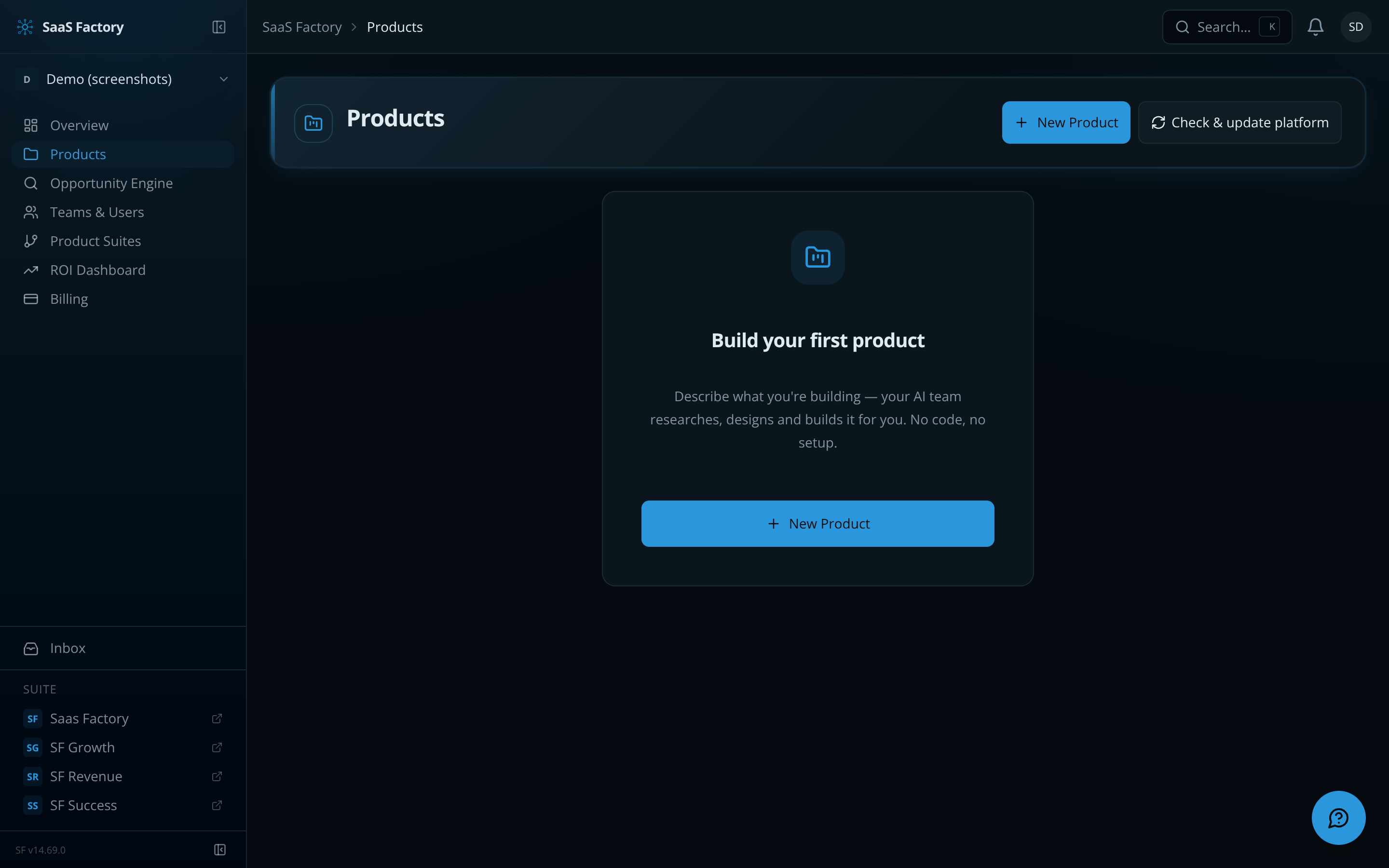
Multi-product dashboard See all client products, pipeline states, and failed runs from a single overview.
Product suites with coordination Manage all your products together — coordinate releases so everything ships in sync.
MCP server per product Every product exposes an MCP endpoint — clients can plug it into Cursor, Claude Desktop, or any MCP-compatible tool.
Competitor re-analysis on a schedule Active competitors are re-scraped weekly — discovered gaps feed the feature queue automatically.
MRR time series, cohort retention, subscriber lifecycle funnel — real SQL, no mock data.
Dunning sequences, win-back campaigns, and upsell triggers run without a sales team.
Spot when products drift apart and coordinate releases so the portfolio ships together.
Every generated product includes a versioned REST API with key authentication and rate limiting — no extra config.
Model Context Protocol server ships with every product. Connect Cursor, Claude Desktop, or any MCP client in minutes.
A dedicated AI worker handles background inference tasks — classify, generate, and act without blocking your product's main thread.
Continuous competitor tracking Competitor sites re-analysed weekly — feature gaps surface as queued work automatically.
Security & compliance agents Dependency scanning, audit logging, and GDPR data handling run as built-in background agents.
Public changelog per product Every release generates a changelog entry and blog post — proof-of-velocity at a public URL.
Observability built in Agent job counts, token usage, and pipeline health tracked per product — no extra tooling.
Competitor sites scraped and diffed
Feature gaps ranked by priority
Queue populated without human input
STAGE 02 — DESIGN
Each queued feature gets a complete technical spec with acceptance criteria, architecture notes, and edge case handling — written by the design agent before a single line of code is written.
Full spec with acceptance criteria
Architecture and edge cases documented
Approval gate available before build
STAGE 03 — BUILD
The implementation agent writes code against the spec, the testing agent runs CI, and a PR is opened. If CI fails, the agent retries up to three times before escalating.
STAGE 04 — SHIP
Once CI passes, the release agent merges the PR, triggers a deployment, and generates a versioned changelog entry with release notes and social posts — all without human involvement.
PR merged and deployment triggered
Changelog entry and blog post generated
Social posts written and stored
STAGE 05 — SERVE
Support tickets are classified and resolved using your knowledge base. Revenue signals are monitored for churn risk and upsell opportunities. The cycle restarts — every 30 minutes, around the clock.
Inbound tickets classified and resolved by AI
Churn risk scored, win-back campaigns triggered
Cycle restarts — it never stops improving
Audit logging, dependency scanning, GDPR data deletion, and SOC2 controls run automatically.
Human-in-the-loop gates let you review before autonomous agents merge — without slowing the pipeline.
Env vars encrypted at rest, pushed to deployment targets, with real-time validation against provider APIs.
