Pricing
We’ve broken the mould. Every plan is baseline subscription plus metered. A fixed monthly fee for your tier, then you only pay for what you use. First the build. Then servers, database, compute and payments once you’re live. Going from 10 customers to 100 won’t send your bill through the roof. Your SF account balance pays as you go. Tiers unlock more as you grow. Startup to get going. Venture for established businesses. Enterprise for scale, security and support.
Usage is charged on top of the plan. Rates can differ by plan — choose one to see its rates.
| Usage item | Price | Included in plan |
|---|---|---|
| AI decisions — jev input | $0.84 per 10,000,000 tokens | None |
| AI decisions — jev output | $0 per 1,000,000 tokens | None |
| AI tokens — haiku cache read | $0.15 per 1,000,000 tokens | None |
| AI tokens — haiku cache write 1h | $3 per 1,000,000 tokens | None |
| AI tokens — haiku cache write 5m | $1.88 per 1,000,000 tokens | None |
| AI tokens — haiku input | $1.50 per 1,000,000 tokens | None |
| AI tokens — haiku output | $7.50 per 1,000,000 tokens | None |
| AI tokens — opus55 cache read | $0.30 per 1,000,000 tokens | None |
| AI tokens — opus55 cache write 1h | $12 per 1,000,000 tokens | None |
| AI tokens — opus55 cache write 5m | $7.50 per 1,000,000 tokens | None |
| AI tokens — opus55 fast:cache read | $0.60 per 1,000,000 tokens | None |
| AI tokens — opus55 fast:cache write 1h | $24 per 1,000,000 tokens | None |
| AI tokens — opus55 fast:cache write 5m | $15 per 1,000,000 tokens | None |
| AI tokens — opus55 fast:input | $12 per 1,000,000 tokens | None |
| AI tokens — opus55 fast:output | $60 per 1,000,000 tokens | None |
| AI tokens — opus55 input | $6 per 1,000,000 tokens | None |
| AI tokens — opus55 output | $30 per 1,000,000 tokens | None |
| AI tokens — sonnet cache read | $0.30 per 1,000,000 tokens | None |
| AI tokens — sonnet cache write 1h | $6 per 1,000,000 tokens | None |
| AI tokens — sonnet cache write 5m | $3.75 per 1,000,000 tokens | None |
| AI tokens — sonnet input | $3 per 1,000,000 tokens | None |
| AI tokens — sonnet output | $15 per 1,000,000 tokens | None |
| AI web searches | $0.15 per 10 searches | None |
| API requests | $0.15 per 1,000 requests | None |
| BandwidthData delivered to your visitors. | $2.25 per 10 gbs | None |
| Build sandbox CPU (per active CPU-hour)CPU time used while your app is being built. | $1.92 per 10 cpu-hours | None |
| Build sandbox creationsEach build environment started. | $0.90 per 1,000,000 creations | None |
| Build sandbox data transfer (per GB)Data transferred while your app is being built. | $2.25 per 10 gbs | None |
| Build sandbox memory (per GB-hour)Memory used while your app is being built. | $3.18 per 100 gb-hours | None |
| CI & package storage | $504.04 per 1,000,000 gb-hours | None |
| CI build minutes | $0.09 per 10 minutes | None |
| Connection API calls | $5.04 per 100,000 calls | None |
| Database backup branches (per branch, per month) | $2.25 per 10 branch-months | None |
| Database compute | $0.33 per compute-hour | None |
| Database restore history | $0.30 per gb-month | None |
| Database snapshots | $1.35 per 10 gb-months | None |
| Database storage | $0.53 per gb-month | None |
| Email domain rental (per day) | $0.10 per domain-day | None |
| Emails sent | $0.06 per 100 emails | None |
| File download transfer (per GB)Files your visitors download. | $0.75 per 10 gbs | None |
| Function invocationsEach time one of your app's functions runs. | $0.90 per 1,000,000 invocations | None |
| Hosting CPU (per active CPU-hour)CPU time your app's functions actively use. | $1.92 per 10 cpu-hours | None |
| Hosting memory (per GB-hour)Memory provisioned for your app's functions. | $1.59 per 100 gb-hours | None |
| Inbound emails | $0.06 per 100 emails | None |
| Origin transfer (per GB)Data your app's servers send to the edge network. | $0.09 per gb | None |
| Package downloads | $0.75 per gb | None |
| Platform seat (per seat, per day)A hosting team seat, per day it is held. | $1 per seat-day | None |
| Static IP data transfer (per GB)Data sent through a static IP. | $2.25 per 10 gbs | None |
| Static IPs (per project, per day)Static outbound IP addresses for one app, per day. | $5 per project-day | None |
| Storage | $3.45 per 100 gb-months | None |
| Storage data transfer out | $0.75 per 10 gbs | None |
| Workflow actions | $0.75 per 10,000 actions | None |
The tiers
Same factory, same journey. What changes is How much you unlock as you grow. Each tier adds more features, scale and support, so you only pay for what your stage needs.
For founders building their first product. One mission statement in, to your first £, €, $ and ¥.
For established businesses launching their next product. Replatform, add adjacent and downstream products, or build solutions for clients.
For larger groups that need enterprise grade scale, security and support. Spec Builder turns your PRDs into products, fast.
Evaluating for Enterprise? Read the Enterprise overview for security, compliance and scalability, all in one place.
FULL TRANSPARENCY
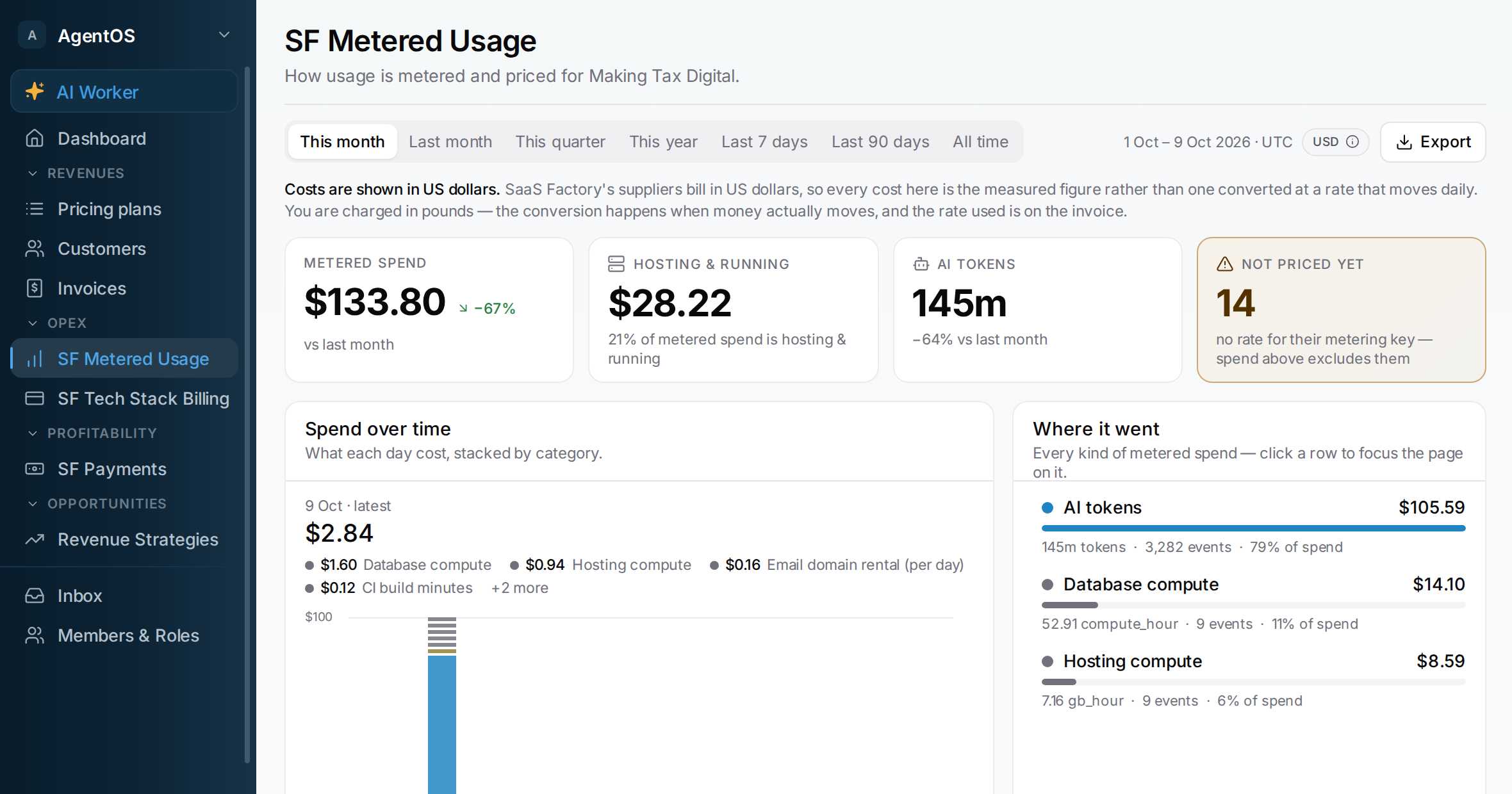
Nothing is hidden. Every cent is shown against what it built: your product, your tech stack, your business stack. So you’re always in full control: You also share our infrastructure, so there are no separate services to find, buy and stitch together. Most software subscriptions are a black box. This one keeps receipts. How it works.
GOOD TO KNOW
Clear pricing means you can plan with confidence. Here are the questions people ask most, answered in plain English. No small print, no surprises..
